Revealed: The Best Cities for UK Families to Relocate To
Insights
Written by
Martin Robinson
Published on
Since 2021 there have been a record number of UK residents leaving the country, families are trying to decide if the idea of better weather, lower living costs or improved quality of life in a different country is worth it. With this in mind, the data team here at Amzonite has developed the 2026 Expat Index, it’s an in depth ranking of global cities to reveal where a British family of four would realistically be better off.
Rather than relying on perception or social media, the index analyses real-world data on affordability, taxes, education quality, visa accessibility and overall living standards. It acts as a reality check on the idea that moving abroad automatically gives you a better life.
“People often romanticise the idea of relocating,” says Martin Robinson, Director at Amzonite. “But the grass isn’t automatically greener. We wanted to create a clear, balanced comparison that shows not just the highs, but also the trade-offs families should be aware of.”
Why the Expat Index Was Created
The UK is going through a steady rise in people leaving and it is thought that it is driven by financial pressure, the rise of remote work, and dissatisfaction with cost of living. For many families, the idea of a new start abroad feels appealing. Yet the practical realities, visa hurdles, tax implications, education quality and whether salaries stretch further, are often not discussed.
“There’s a gap between ideas and reality. Families are asking, ‘Will we genuinely be better off, or are we just swapping one set of challenges for another?’ Our aim was to take that question and test it with data rather than assumptions.”
How the Index Works
The countries in the index were selected by the amount of UK citizens moving there. The major cities within these countries included in the analysis were evaluated against six weighted categories. Quality of life and education were weighted most heavily (25% and 20% respectively), followed by tax exposure (20%), cost of living (15%), visa ease (15%) and visa costs (5%). All metrics were normalised relative to one another, allowing each city to be compared fairly.
“We built a model that reflects real priorities. Families want safety, stability, education and reasonable costs. When you look at all of those together, the results become much more interesting than simply choosing the warmest place or the cheapest rent.”
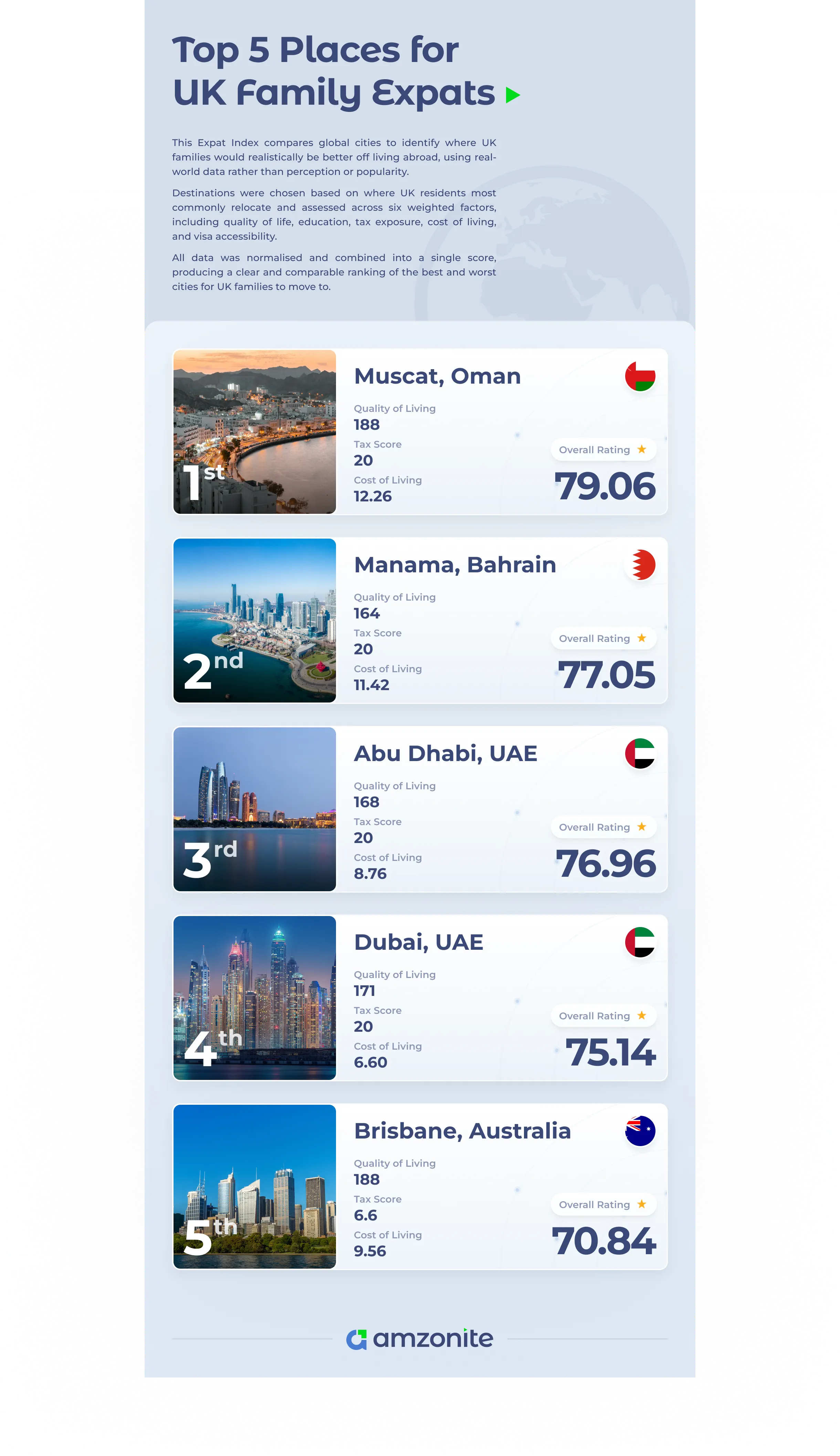
The Top 5 Cities for UK Families to Move To
1: Muscat, Oman
Muscat takes the top spot thanks to a strong education score, low taxes, comparatively manageable living costs and a visa process that is more straightforward than many families expect. Its stability helps contribute to its overall score.
2: Manama, Bahrain
Manama performs strongly across almost every metric, balancing high-quality public services with a low tax burden. Its investment in the international schools sector and modern infrastructure make it more attractive for relocating families.
3: Abu Dhabi, United Arab Emirates
Abu Dhabi scores highly on education, safety, and infrastructure, with a tax environment that allows family incomes to stretch significantly further. While rent sits on the higher side, the overall quality of life offsets the cost.
4: Dubai, United Arab Emirates
Dubai remains a global expat hub for good reason. Although lifestyle costs vary widely, its strong education system, safety record and accessible visa pathways lift it into the top four.
5: Brisbane, Australia
Brisbane is the only Western destination to break into the top five. Lower living costs than Sydney and Melbourne, combined with the strongest education score and solid quality-of-life metrics, make it one of Australia’s most balanced cities for families.
“What stands out is that the highest-performing cities aren’t necessarily the most obvious. People talk about Australia or Canada, but they rarely consider the Gulf states as family destinations, and yet they dominate the top of the list.”
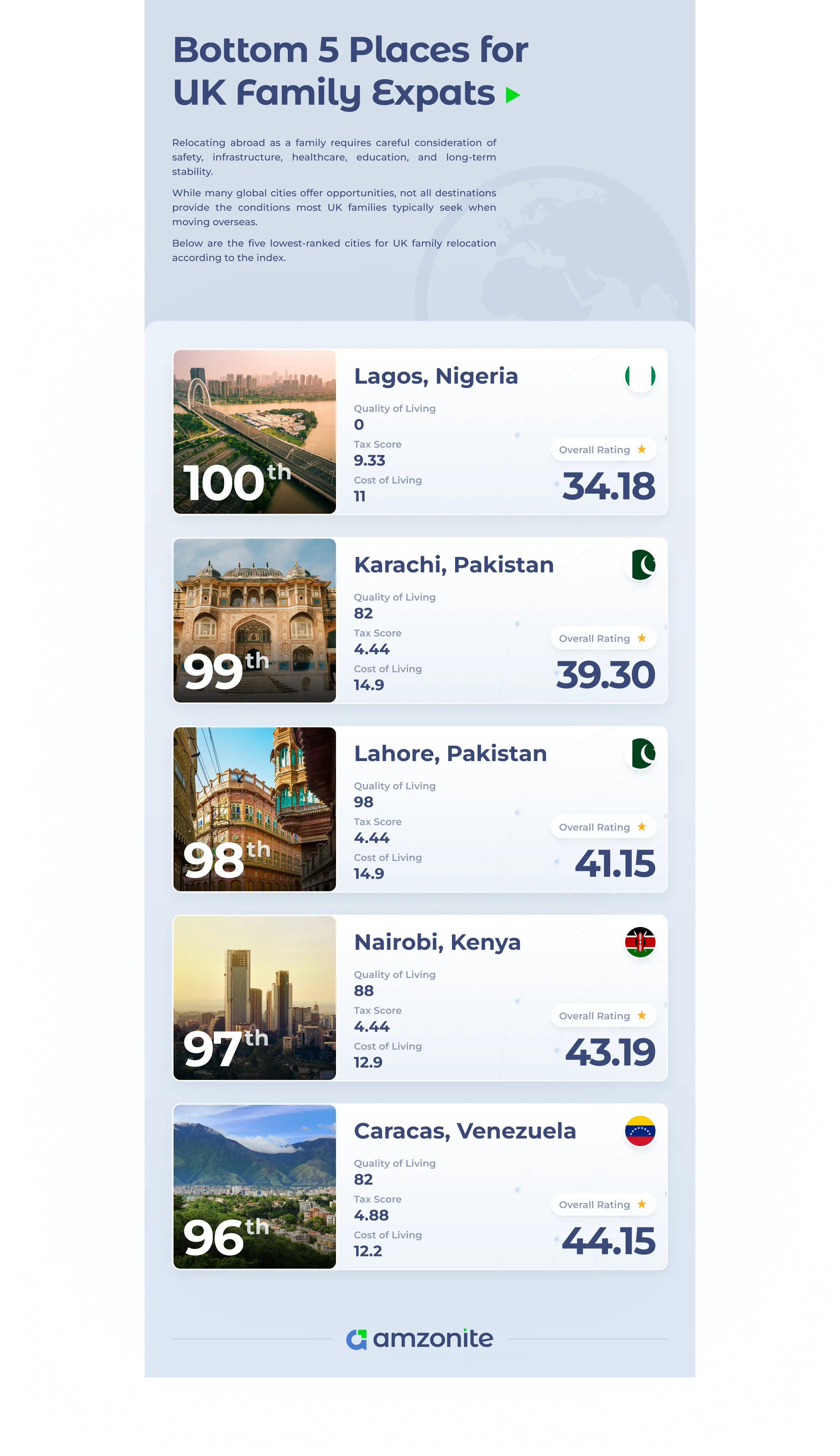
The Bottom 5 Cities
100: Lagos, Nigeria
Lagos ranks lowest in the index due to challenges across education, safety, and cost predictability.
99: Karachi, Pakistan
High taxes, lower quality-of-life scores and visa difficulties contribute to Karachi’s placement.
98: Lahore, Pakistan
Lahore faces similar systemic issues as Karachi, with lower education scores being a key factor in its ranking.
97: Nairobi, Kenya
While Nairobi offers natural beauty and recent economic growth, it scores lower on safety, education and visa accessibility.
96: Caracas, Venezuela
Economic instability and infrastructure challenges outweigh its affordability, placing it in the lower tier.
Robinson notes that “affordability alone doesn’t make a city suitable for families. Stability, education and long-term opportunity matter just as much, if not more.”
Three Major Surprises in the Data
Although the overall rankings offer one side of the story, several findings stand out against what you might think.
New York’s Surprisingly Low Position
Despite being one of the world’s most iconic cities and a favourite when it comes to aspirational places to move to, New York ranks far lower than many people would think. Extremely high rental prices, high taxes and one of the most complex visa systems for UK citizens act as major barriers.
“As much as people dream of New York,” Robinson says, “the data shows it’s one of the most financially challenging places for a family to relocate to. The numbers simply don’t support the fantasy.”
Middle Eastern Cities Outperform Europe and North America
The dominance of Muscat, Manama, Abu Dhabi and Dubai highlights a broader trend that cities with low taxation, strong education infrastructure and streamlined visa systems offer advantages Western destinations struggle to match. This finding is opposite to long-held assumptions about where families can access the best quality of life.
Australia Shows a Split Personality
While Brisbane ranks in the top five, Sydney and Melbourne fall just behind due to higher living costs. This reveals a significant internal disparity within Australia which is often treated as uniformly expat-friendly, especially for people from the UK.
Is the Grass Greener?
The Expat Index reveals that the answer is both yes and no. Life can be better abroad for UK families, but not necessarily in the places they might imagine. The destinations offering the strongest balance of affordability, opportunity and long-term stability are often overlooked in popular narratives.
Robinson concludes: “The goal isn’t to tell families where to go. It’s to give them the clarity they deserve. The data shows that greener grass exists, but it’s not always where the postcards suggest.”
Methodology
The Index was compiled using a combination of official government data, internationally recognised third-party survey datasets, and publicly available sources. Cost of living and rental estimates were drawn from global consumer price and housing markets, while quality of life and education scores were based on international indices and development indicators. Tax data was sourced from national revenue authorities, and visa cost and visa accessibility ratings were from official immigration portals and embassy guidance. All metrics were normalised to ensure comparability across cities and then weighted according to their relative importance to relocating families, producing a final Total Score for each destination.
The weighting is as follows:
Quality of Living - 25%
Tax - 20%
Education - 20%
Cost of Living - 15%
Visa Ease - 15%
Visa Cost - 5%
Latest Insights
Fresh perspectives, smart trading strategies, and market news from Amzonite.
It is generally thought that financial markets evolve through prices and policies, but they can also evolve through language. In times of change, the words used to describe investing often become blurred, oversimplified, or misunderstood.
If you’ve built a strong financial foundation, whether through business, career success, or inheritance, investing wisely is the next step in preserving and growing your wealth.